
How to Specify Spring Wire Diameter and Load for an RFQ
Wire diameter and load are the two values that most influence a spring's behavior and cost. Getting them right in the RFQ means fewer quote revisions and a part that performs as designed.
A complete specification separates wire diameter, outside diameter, and load so there is no room for misinterpretation.
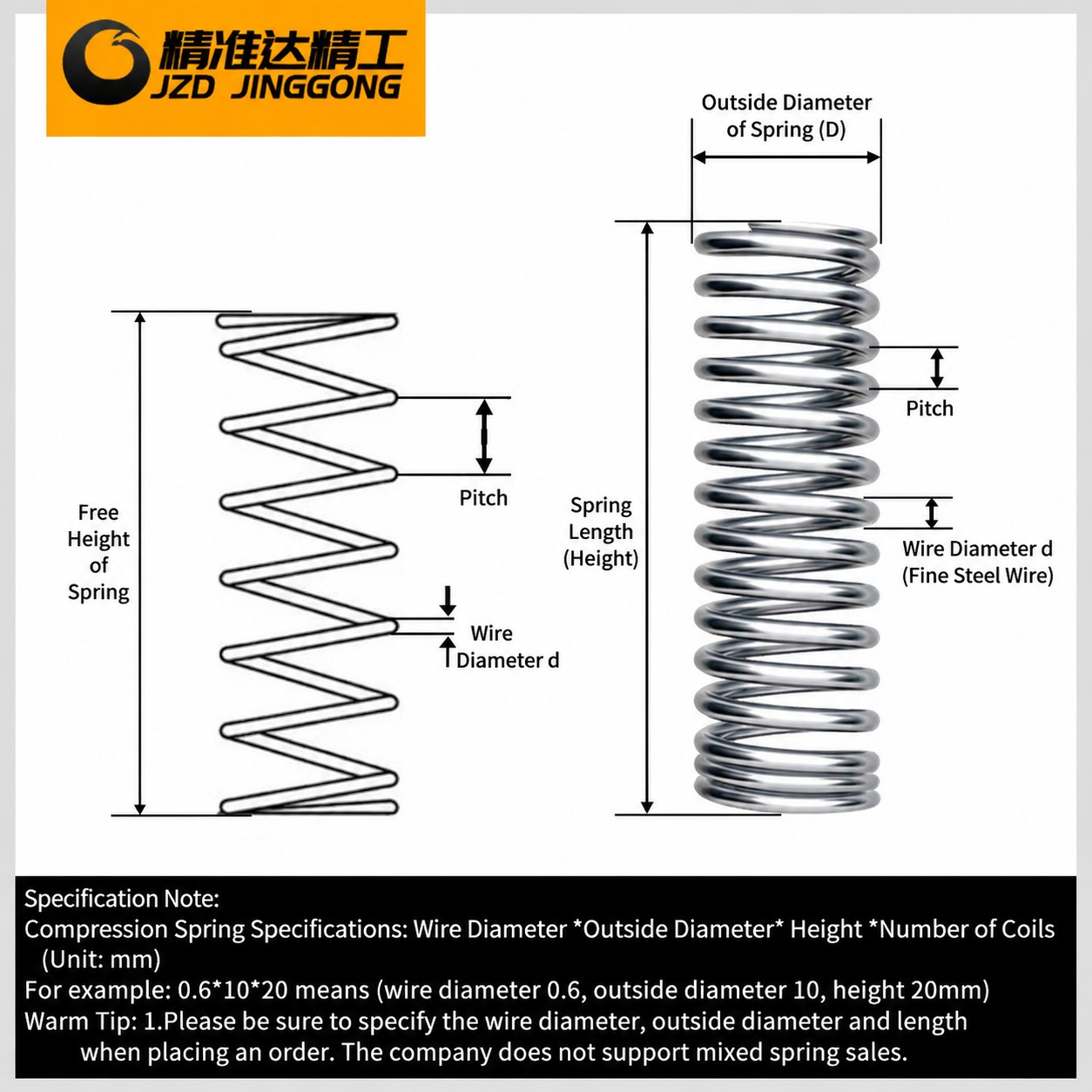
Wire diameter vs outside diameter
Wire diameter is the thickness of the wire itself. Outside diameter is the full width of the coil. The two are easily confused, and swapping them changes the spring rate and fit.
Always list both. For a compression spring, also state the inside diameter or the mating rod and bore so the spring seats correctly.
Rate, load, and free length
| Term | Meaning | Why it matters |
|---|---|---|
| Free length | Length with no load | Sets the starting point |
| Rate | Force per unit of deflection | Determines feel and travel |
| Working load | Force at a given height | The requirement the spring must meet |
| Solid height | Length when coils touch | Maximum compression limit |
Instead of only giving a free length, give the load at a specific compressed height. For example, "18 N at 20 mm height." This ties the spec to the real requirement.
Tolerances and realistic targets
Tighter tolerances raise cost and lead time. State the tolerances only where they are functionally necessary. A reasonable range on wire diameter and length keeps the part affordable and manufacturable.
If you are unsure what tolerance is practical, ask the supplier before locking the drawing.
A complete RFQ checklist
- Wire diameter and outside diameter.
- Free length and number of coils.
- End type (closed ground, closed, or open).
- Material and surface finish.
- Working load and compressed height, or spring rate.
- Tolerances that are functionally required.
- Annual quantity and target delivery.
A drawing that contains these fields lets a supplier quote on the first pass without follow-up questions.
FAQ
What if I only know the load, not the wire diameter?
That is normal. Provide the load, travel, space available, and material, and the supplier will calculate the wire diameter and other dimensions for you.
Should I specify inside diameter or outside diameter?
Both are useful. Outside diameter defines the space the spring occupies; inside diameter must clear the guide rod or bore.
What is a spring rate and do I need it?
Rate is force per unit of deflection. If you have a specific load at a specific height, rate can be calculated. Supply whichever you know best.
How tight should my tolerances be?
Only as tight as the function requires. Ask the supplier what range is standard for your size, then tighten only the critical dimensions.
Can you reverse-engineer a spring from a sample?
Yes. Send the sample and the supplier can measure wire diameter, coil count, and free length, then quote a matching or modified part.
Do I need to know the number of coils?
It helps but is not required. The supplier can calculate coil count from your load and travel requirements.
Send a spec the supplier can quote directly
A spring RFQ with wire diameter, outside diameter, working load, and material is quick to quote. Include a drawing or sample and the supplier can return an accurate price and lead time.
Send your drawing or sample with load and material requirements, plus your target quantity, to get a detailed quote.
Browse the Precision Springs catalog for related parts, or submit your specifications to request a quote.